

When I was just starting my finance career as an associate in investment banking, I read through dozens of corporate filings every day. I was looking for trends, comparing one business against another to see how they performed on revenue growth, profitability, and return on investment for their shareholders. These dense documents can be gold mines for understanding the details of a business and why one company can outperform another.
Why publicly traded companies are required to report financials
Publicly traded (or simply, “public”) companies don’t publish financial statements out of goodwill. After the stock market crash in 1929 and resulting Great Depression, Congress passed the Securities Exchange Act of 1934 and formed the Securities and Exchange Commission (SEC) to regulate financial markets. Today, any publicly traded company listed on a US exchange must provide transparent, audited financial disclosures to the SEC. The goal of this mandate is to ensure that capital markets operate efficiently, preventing insider trading fraud and misleading statements from company executives.
The two main financial disclosures every investor and operator tracks are:
Form 10-K: The comprehensive annual report covering audited financial statements, risk factors (Item 1A), and Management’s Discussion & Analysis (MD&A / Item 7).
Form 10-Q: The quarterly, unaudited update tracking performance across three individual quarters.
Introduction to the three financial statements
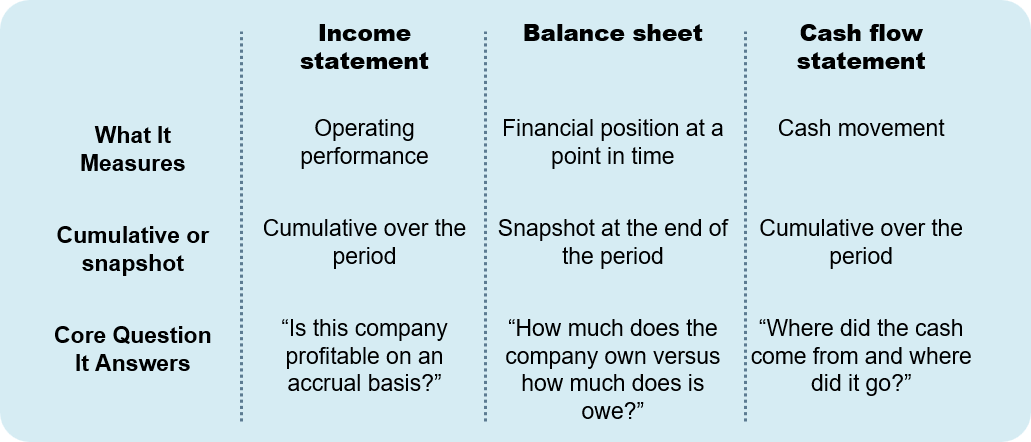
In both the Form 10-K and Form 10-Q, the company will report three key financial statements:
Income statement (also called “Consolidated statement of operations” in the Forms) showing total revenue, expenses, and net income for the period.
Balance sheet reporting total assets, liabilities, and equity at the end of the period.
Cash flow statement showing the total cash generated from operations, from investing (or capital expenditures aka “capex”), and from financing such as issuing debt or stock.
Real world example
Let’s consider the company, Block, Inc. [ NYSE: XYZ ], the fintech company that owns consumer-facing apps like Cash App and Square and crypto platforms like Bitkey and Proto.
If we look at Block’s latest 10K, we can see the following trends:
On the income statement, Revenue for 2025 was essentially the same (“flat”) to 2024, due to declines in the bitcoin ecosystem. After all expenses, net income profit margin was 5% for 2025, down from 12% in 2024, driven by increased operating expenses and higher interest expense.
On the balance sheet, we can see that the main changes in assets are growth in the “loans held for investment,” originating from a new product called “Cash App Borrow” that the company launched in 2025.
On the cash flow statement, you will see that Block has a lot of activity in the “cash flows from investing” section. For a standard widget-type company, this section would usually include only a few transactions from buying or selling large equipment (aka ‘capital expenditures’). Since Block is a fintech company that holds customer funds and offers borrowing, they use “marketable debt securities” like government bonds to manage customer funds safely and earn interest on the cash that they hold for their customers.
The Takeaway: A single financial statement only gives you a single dimension of information. To evaluate a company's financial health, you need to consider how all three statements connect.
Suggested Exercise
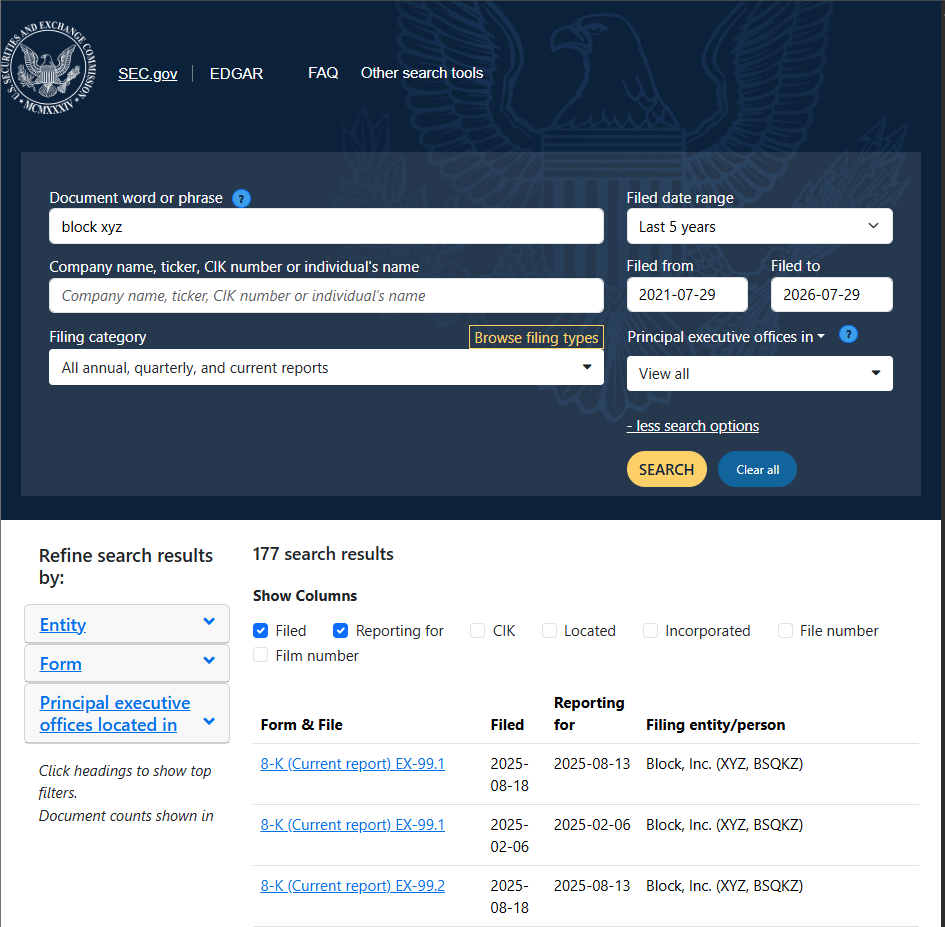
Try checking out the SEC EDGAR website to look up financials for a company you’re interested in. You can also use AI tools like Gemini Notebook to collect several 10Ks and 10Qs and chat with Gemini about the reports.
© Katherine Dextraze, F Avenue Consulting, 2026