

In July 1985, seven former Linkabit engineers led by Irwin Jacobs gathered in San Diego, California, and founded a company called “Quality Communications” or Qualcomm for short. Across the pond in London, Sade began her illustrious career as a vocal artist. Both have continued to deliver understated quality ever since.

Qualcomm initially operated as a contract R&D lab. To fund its ambitious research into a little-known wireless technology called Code-Division Multiple Access (CDMA), the fledgling firm built and sold a satellite tracking system called Omnitracs for trucking fleets. That early satellite revenue funded the foundational patents that eventually defined 2G, 3G, 4G, and 5G global mobile standards.
By the late 1990s, Qualcomm made a pivotal strategic decision: it sold off its capital-intensive cell phone and base-station manufacturing divisions to focus strictly on its highest-margin assets, intellectual property licensing and custom fabless chip design.
That early San Diego playbook still dictates Qualcomm’s strategy today: own the foundational technology standards, operate a capital-light fabless model, and collect recurring cash flows across every connected device on earth.

So, if Qualcomm built such a remarkable business, why isn’t anyone talking about it?
The market and investor content creators are obsessing over Nvidia like like Miley Cyrus swinging in on a wrecking ball — churning out dramatic headlines, wild price swings, and hyper-growth expectations. On the other hand, Qualcomm has been smoothly operating like a long-duration compounder with a diversified, capital-light business model surrounded by a deep moat.
To see why this “quiet storm” deserves the coveted “compounder” label, let’s put Qualcomm side-by-side against Nvidia and Intel using the 4-pillar framework.
The 4-Pillar Compounder Scorecard: Semiconductor Edition
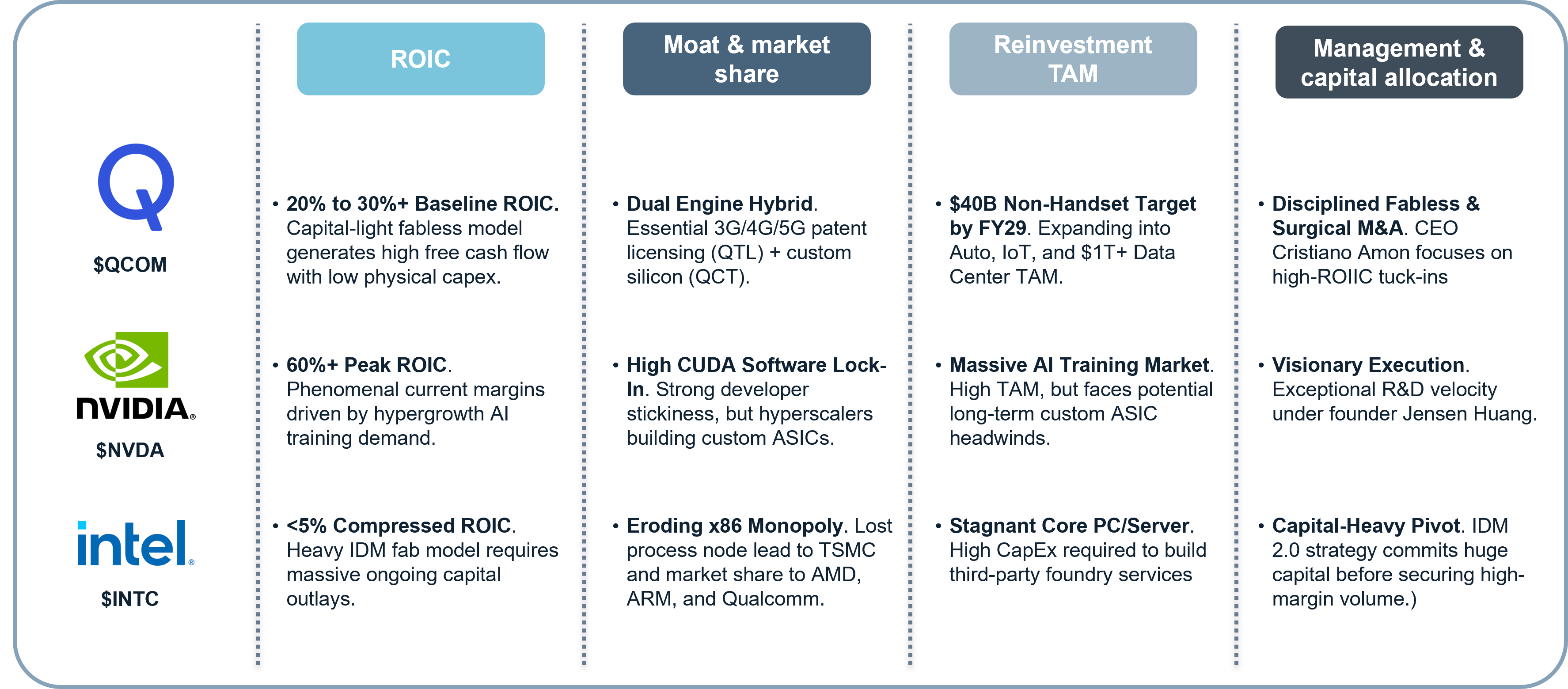
Pillar 1: Financial Returns & Navigating the Fabless Trade-Off (ROIC & ROIIC)
Qualcomm QCOM 0.00%↑ generates a baseline ROIC of 20% to 30%+, well above its 8% WACC. Because it operates a capital-light fabless model, it outsources the multi-billion-dollar burden of building physical factories to foundries, allowing R&D dollars to flow directly into high-margin silicon designs and patent portfolios.
But being fabless comes with a critical operational trade-off: you don’t own the factories and you could be sharing capacity with your direct competitors. Qualcomm must compete directly against Apple and Nvidia for leading-edge wafer allocation at TSMC. So, if foundry capacity gets tight or wafer costs rise, won’t that make the fabless approach look little less fabulous?
To protect its high ROIC without tying up tens of billions in physical plant capex, Qualcomm executes a multi-layered supply security strategy:
Multi-Foundry Dual-Sourcing: Unlike competitors who rely exclusively on TSMC, Qualcomm splits flagship silicon volume between TSMC and Samsung (alongside GlobalFoundries for specialty nodes), providing supply redundancy and pricing leverage.
Capacity Advance Commitments: Qualcomm uses its massive balance sheet to sign long-term purchase agreements backed by cash prepayments, announcing over $10.5 billion in 12-month purchase obligations and nearly $2 billion in advance capacity payments to lock in dedicated leading-edge wafer allocation years in advance.
By solving the supply equation without building physical fabs, Qualcomm preserves its capital-light model and keeps its ROIIC exceptionally high.
Pillar 2: Moat Durability & Customer Captivity (QTL + QCT)
A company's moat determines whether its high ROIC survives competitive attack over decades. Qualcomm's competitive moat is structurally unique in the semiconductor industry when compared to both Nvidia and Intel:
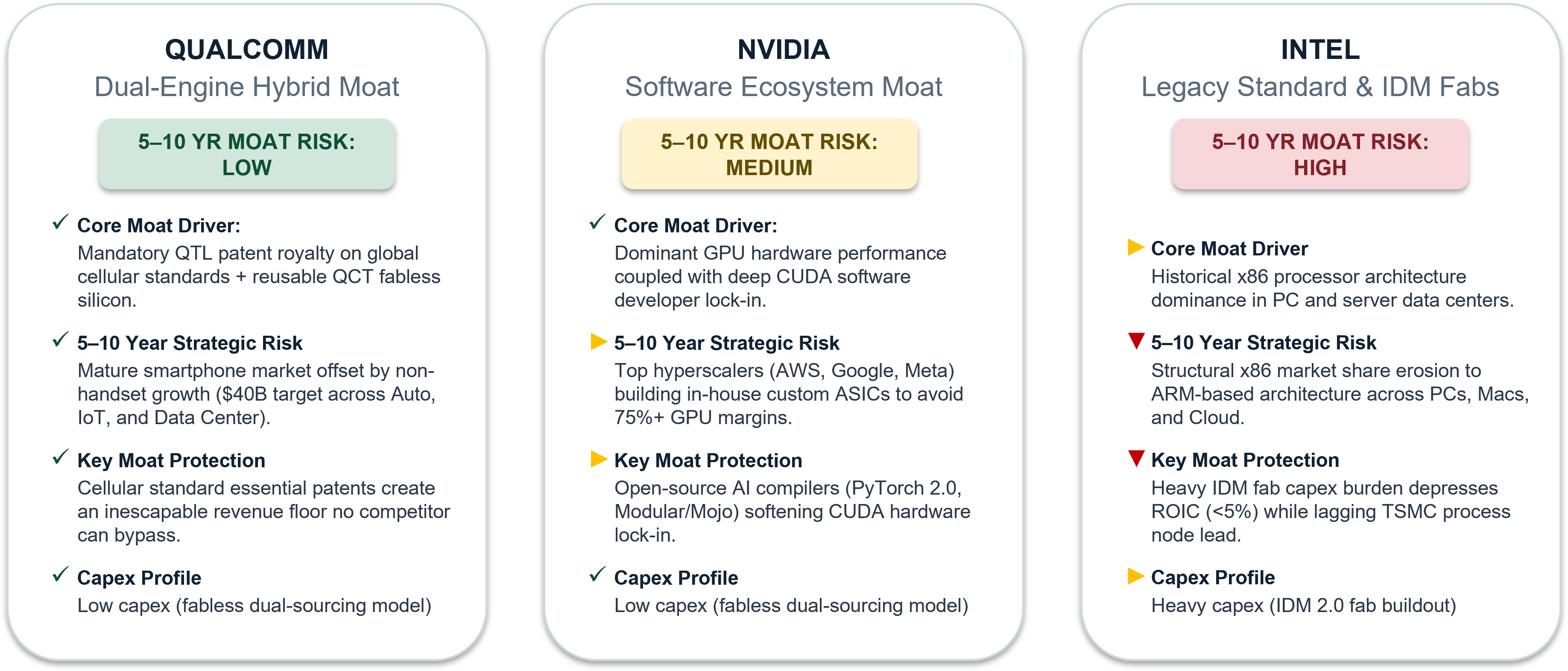
Qualcomm: The Dual-Engine Hybrid Moat
Qualcomm operates a dual-engine moat that combines mandatory patent licensing (QTL) with custom fabless silicon design (QCT):
Engine 1 (QTL: The Universal License): Qualcomm holds standard essential patents (SEPs) covering 3G, 4G, and 5G cellular communication. Because international telecommunication frameworks require these standards, hardware manufacturers pay Qualcomm a recurring royalty fee on cellular-connected devices regardless of whose processor sits inside. QTL operates at 69% to 73% EBT margins, generating a predictable, cash-flow floor that funds long-term R&D.
Engine 2 (QCT: Reusable IP Scale): Qualcomm designs low-power compute, Wi-Fi, Bluetooth, and NPU neural processing IP blocks. Once an IP block is engineered for smartphones, Qualcomm reuses that same core technology across automotive cockpits, industrial edge devices, and data center AI platforms with minimal incremental capex.
Nvidia: The Software Ecosystem Moat
Nvidia’s moat is based on its proprietary CUDA software platform paired with GPU hardware leadership in AI training.
CUDA creates deep developer stickiness because AI models are optimized specifically for Nvidia hardware. However, Nvidia lacks a mandatory patent licensing engine like QTL.
The risk is that Nvidia’s four largest hyperscaler customers (representing over 60% of revenue) are actively designing custom in-house ASICs that will erode it’s currently high hardware margins over time.
Intel: The Eroded Legacy Moat
Intel historically relied on its x86 instruction set monopoly and proprietary manufacturing fabs.
Intel lost process manufacturing leadership to TSMC, undermining both its performance advantage and its cost structure and eroding Intel’s moat.
Unlike Qualcomm’s fabless approach, Intel’s capital-heavy IDM model requires building multi-billion-dollar fabs before securing high-margin customer volume.
Pillar 3: Reinvestment Runway & TAM Expansion ($1.0T+ Data Center)
A compounder isn’t simply a high-ROIC cash cow; it also needs a large, expanding runway to reinvest retained cash at high returns. For Qualcomm, moving from a mature smartphone market into adjacent growth categories creates the exact multi-decade growth runway Munger looked for.
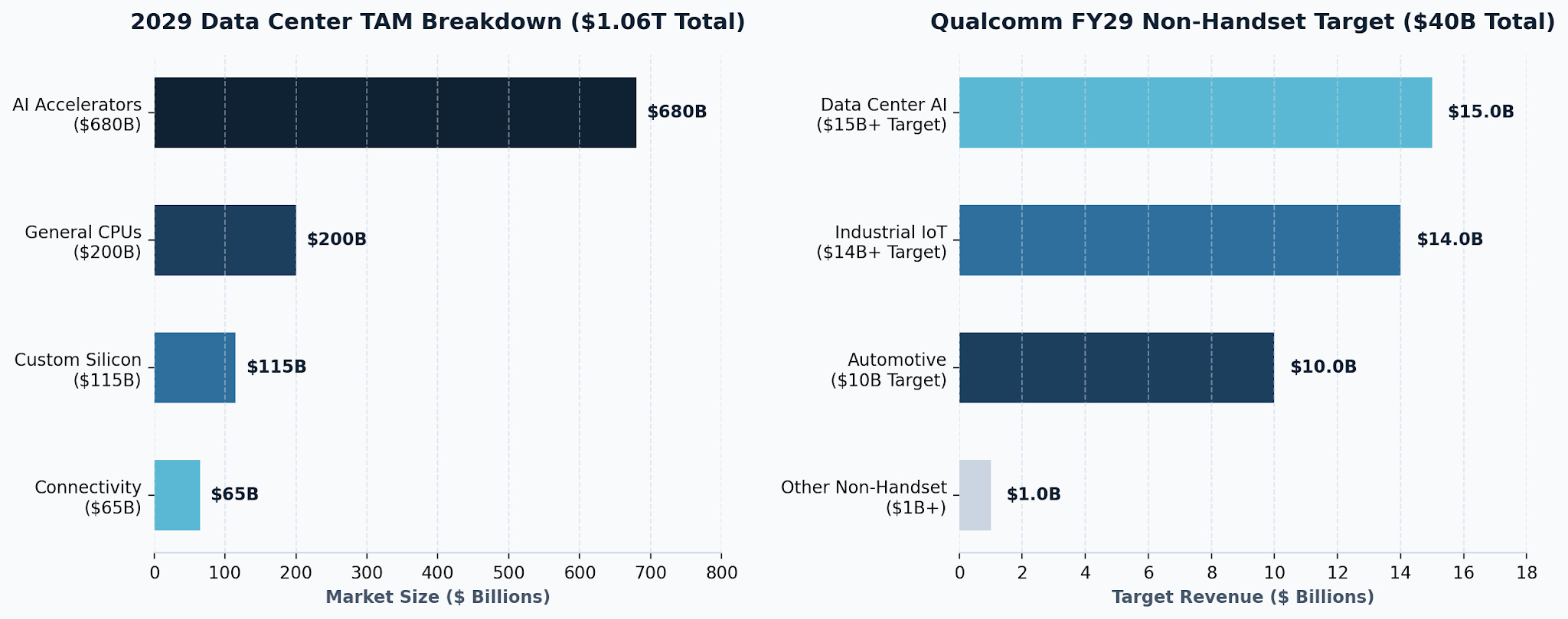
Management has expanded its non-handset revenue target to $40 billion by FY2029 across three primary growth vectors:
Automotive ($10B Target by FY29): Snapdragon Digital Chassis powers digital cockpits, telematics, and automated driving for OEMs like BMW, Stellantis, and GM.
Industrial & Embedded IoT ($14B+ Target by FY29): Dragonwing processors deliver edge AI, computer vision, and offline machine learning across industrial automation, robotics, and smart retail.
Data Center AI ($15B+ Target by FY29): The Qualcomm Dragonfly platform targets energy-efficient AI inference, offering rack-scale custom silicon and CPU solutions for cloud hyperscalers like Meta and Amazon.
The 2029 Market Share Picture
Rather than fighting for scrap market share in saturated categories, these expansion vectors allow Qualcomm to target the massive $1.0+ Trillion Data Center TAM by 2029.
Overall Market Penetration (~1.5% to 2.0% Share): Qualcomm’s $15.0+ billion FY29 Data Center revenue target represents a focused 1.5% to 2.0% slice of the overall $1T+ market. In a trillion-dollar category, capturing even 1.5% share adds $15 billion in high-margin semiconductor revenue.
Custom Silicon Target (>5.0% Share): Within the $115 Billion Custom Silicon TAM (hyperscaler ASICs for cloud giants like Meta and Amazon), Qualcomm is targeting greater than 5% market share.
Reinvestment Pipeline: Combined with Automotive ($10B target) and Industrial IoT ($14B+ target), these growth vectors elevate Qualcomm’s non-handset revenue target to $40 billion by FY2029, demonstrating that its reinvestment runway is wider today than at any point in its 40-year history.
Pillar 4: Management Discipline & Capital Allocation (Surgical M&A)
Like a Smooth Operator, Qualcomm uses targeted, capital-light acquisitions to acquire critical IP, fast-tracking its entry into expanding markets while maximizing ROIIC.
Nowhere is this clearer than in Qualcomm’s expansion into Data Center AI. Qualcomm completed two complementary acquisitions that build both the physical and software layers of its new Qualcomm Dragonfly server platform:
The Physical Layer : Alphawave Semi ($2.3B–$2.4B): Integrates high-speed wired interconnect IP with custom Oryon server CPUs, enabling high-bandwidth communication across rack-scale server architectures.
The Software Layer : Modular Inc. (~$3.9B All-Stock): Founded by LLVM and Swift creator Chris Lattner, Modular provides an open AI software platform featuring the MAX inference engine and Mojo language designed to run models efficiently across hardware architectures and bypass proprietary Nvidia’s CUDA software lock-in.
By executing surgical tuck-ins rather than multi-billion-dollar fab builds, management fast-tracks time-to-market, maintains high operating leverage, and keeps Qualcomm’s corporate ROIIC near peak levels.
The Bottom Line for Investors
From its origins in San Diego to its position as a global connected compute leader, Qualcomm demonstrates the power of capital discipline.
By backing its core cellular patent licensing business with targeted acquisitions in automotive, edge IoT, and data center AI, Qualcomm keeps its baseline ROIC near 30% while opening up a $40 billion non-handset growth runway. For long-duration investors, Qualcomm is one of the purest examples of a “one-decision” compounder in the technology sector.
Really solid breakdown. The QTL licensing business is an underappreciated ballast, and QCT’s low-power strengths look well-positioned as AI shifts more toward inference. The recent Amazon and Meta deals make the data-center runway feel more real than it did a year ago. Between automotive and data center, which one do you think hits meaningful scale first?
Great article! Really appreciated the clarity on QCOM’s moat and data center outlook.