

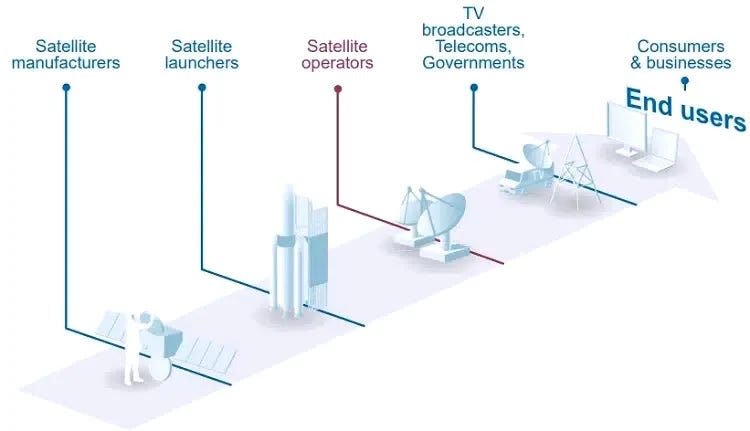
The global satellite communications market is no longer just about launching metal into orbit—it has become a high-stakes, end-to-end land grab. SpaceX’s Starlink is driving massive structural change across the industry by utilizing its sheer launch scale to commoditize bandwidth and squeeze traditional Geostationary (GEO) operators. To survive, legacy players are realizing they can’t just rely on buying third-party launches; they must vertically integrate.
This brings us to Rocket Lab’s (RKLB) massive $8.0 billion acquisition of Iridium (IRDM).
The Deal Mechanics & Strategic Rationale
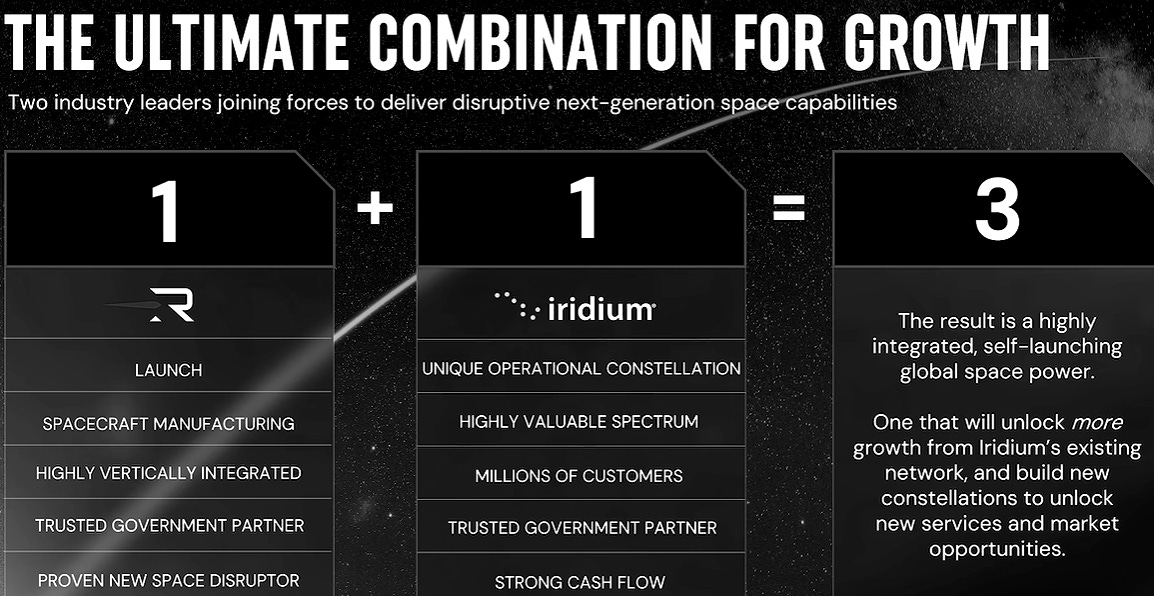
Rocket Lab is buying Iridium for $54 per share in a cash−and−stock transaction (~24% premium over Iridium's closing price on June 26, 2026). Iridium shareholders will receive $27 per share in cash and the rest in Rocket Lab stock.
The strategic rationale is that Rocket Lab gets immediate entry into high-margin space-based applications, globally coordinated L-band spectrum, and a highly profitable customer base of 2.55 million active subscribers. Meanwhile, Iridium secures cost-effective, margin-free access to space via Rocket Lab’s upcoming medium-lift Neutron rocket to replenish its constellation down the road.
The Funding Dilemma: Capital Structure Trade-Offs
How you fund a massive acquisition completely reshapes the future company. Rocket Lab is pulling three distinct funding levers, each carrying heavy corporate finance trade-offs:
Cash on the Balance Sheet: Rocket Lab entered the deal with a comfortable $1.38 billion in cash. While spending cash is the cheapest funding source (zero interest or dilution), draining the treasury leaves Rocket Lab with zero cushion to fund the final, capital-intensive development of the Neutron rocket.
Debt Financing: Rocket Lab secured a $3.6 billion senior secured bridge loan. While debt keeps equity holders from being diluted, it has a painful catch: pro forma leverage will increase above 7x. Because Rocket Lab doesn’t generate positive EBITDA yet (it posted negative $12 million in Q1), this increased debt load can create a heavy burden of fixed interest expense that has already prompted S&P to place Iridium on a CreditWatch Negative.
Equity Issuance: Paying Iridium shareholders with newly minted RKLB stock de-risks the balance sheet but heavily dilutes existing shareholders. If Neutron faces launch delays, the stock could pull back, forcing Rocket Lab to issue even more shares under the transaction’s collar agreement, compounding the dilution risk.
The Ripple Effects Across the Satellite Sector
This deal puts intense pressure on peers like EchoStar (ECHO), Globalstar (GSAT), Telesat (TSAT), and AST SpaceMobile (ASTS) to find their own vertical scale.
But what about the GEO giants? Take Viasat (VSAT), which recently completed its own transformative acquisition of Inmarsat. Viasat is currently trading at ~$86 (up from $73 last week, following their strong earnings report), yet Wall Street’s price targets are vastly higher.
Is Viasat massively undervalued, or is the market underestimating the LEO threat? We will break down Viasat’s valuation and the math behind those analyst targets in our next post.
i am pretty excited for the satellite value chain consolidation. its about time. there is so many things that people are missing out, because the assets are not valued properly, and its really interesting. your post got bme thinking of spectrum licenses which aern't really on the balance sheet. i find that everyone is valuing the hype like spacex but forgot that when the upstream gets commoditized, so will cost in the value chain reduce significantly
This was a great read! I never realized the race for space had so many players. Really great break down of Rocket Labs acquisition of Iridium, thanks for sharing your insights!