



It’s June 2021 and Shaquille O’Neal — four-time NBA champion, platinum-certified rap artist, and beloved actor — is working on his fourth career as an entrepreneur and investor. His first special purpose acquisition company (SPAC), Forest Road Acquisition Corp, raised $300 million to fund a $2.9 billion three-way merger with the fitness platform Beachbody and Myx Fitness Holdings (now trading as BODI). His second SPAC, Forest Road Acquisition Corp. II, is pursuing a tech-media-telecom deal with three former Disney execs as advisors.
Just a few years ago, SPACs were all the rage. SPAC-evangelists pitched them as a democratized fast-track to the public markets, while early institutional investors treated them like a risk-free playground.
But how did this “free lunch” actually work, and why did the excitement dissolve so quickly?
What does a SPAC do?
In simple terms: pretty much nothing on its own.
It has no operations, no products, and no employees of its own. It exists for one reason: to act a placeholder on the stock exchange and raise a pile of cash from the public through an initial offering, and then find a real, private business to merge with. When the merger closes, that private company takes over the SPAC’s spot on the stock exchange, essentially going public through a back door. This means that private companies can get listed more quickly (3-6 months), with less financial and regulatory scrutiny, instead of the grueling 12-18 months timeline for traditional IPOs.
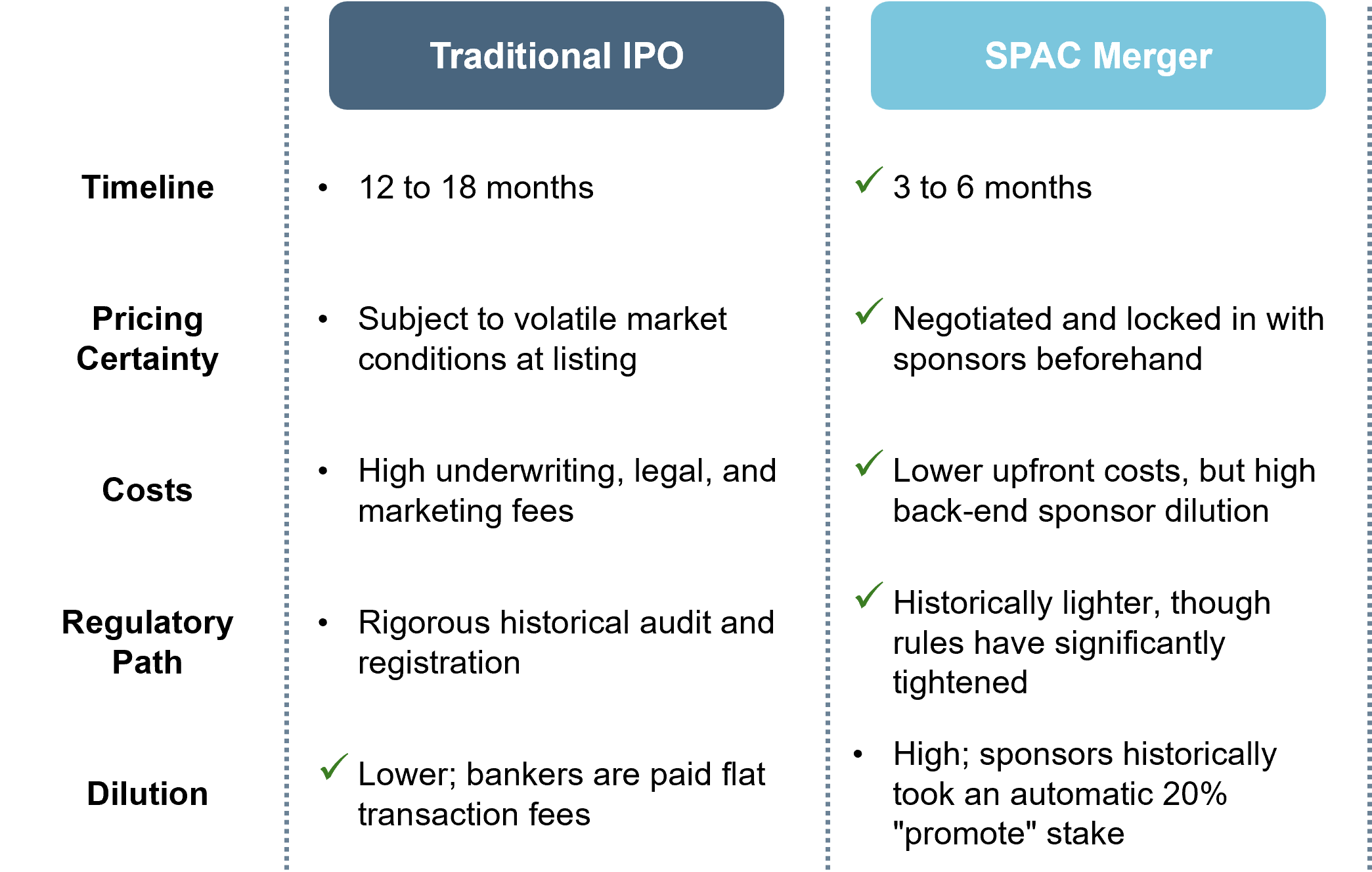
For investors, the process looks like this:
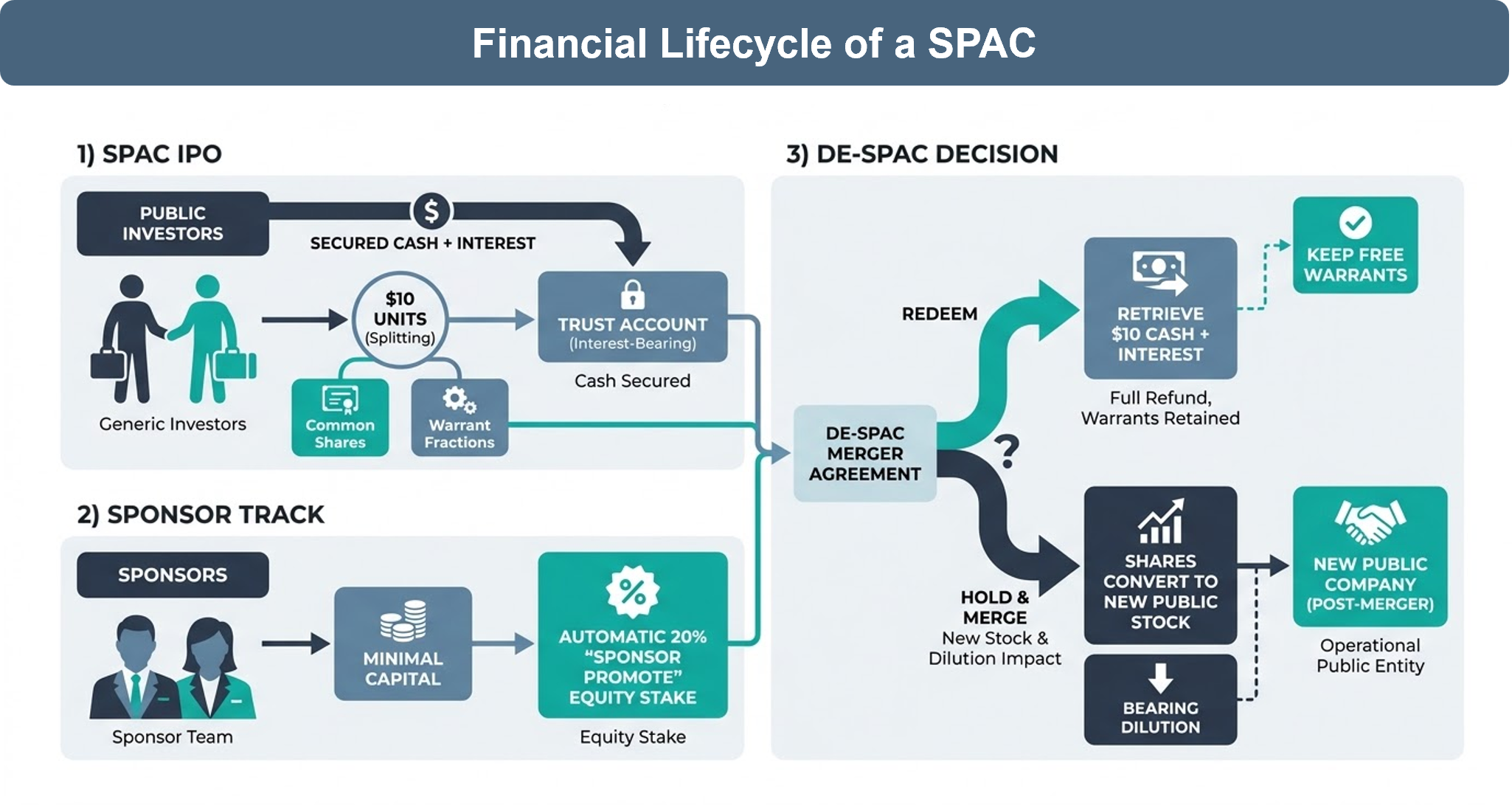
The Blank Check: The SPAC goes public, typically selling shares to investors at a standard price of $10.00 each.
The Waiting Room: All that cash is placed into a secure, interest-bearing trust account. It sits there untouched, buying safe government securities while the sponsors hunt for a business to buy.
The Choice: When the sponsors find a target company and propose a merger, the public shareholders get to vote. But they also get a crucial fallback: if they do not like the deal, they can redeem their shares and get their full $10.00 back, plus any accrued interest, straight from the trust.
The Redemption Loophole: Public Investors vs. Sponsors
The reason big institutional investors (sometimes called the “SPAC Mafia”) poured billions into these structures was a unique structural loophole. When a SPAC first goes public, investors buy “units” that package common stock with a fraction of a warrant (a right to buy more shares at $11.50 in the future).
If an institutional fund disagrees with a proposed merger, they can redeem their shares to get their $10.00 back with interest. However, they still get to keep those warrants for free. If the merged company’s stock spikes on retail hype, they can cash in those warrants for a tidy profit; if it crashes, they lose nothing because their principal is already safe in their pockets.
Meanwhile, the sponsors put up the initial risk capital to cover upfront expenses and get an automatic 20% equity stake (the “promote”) for putting the deal together. If the merger goes through, they realize massive gains even if the stock performs poorly post-merger.
This left long-term public shareholders to absorb all the dilution from the free warrants and sponsor promote, bearing the full brunt of the post-merger consequences.
Where SPACs got their start: from the 1980s to SPAC 4.0
SPACs are often talked about as a recent invention, but their roots go back decades:
The 1980s “Blind Pools”: Early versions were often used to fund highly speculative ventures like oil and gas exploration. They were so frequently associated with retail fraud and penny-stock scams that the federal government ultimately stepped in with heavy regulations under Rule 419 to protect investors.
The 1993 Modern Safeguards: To rebuild trust, David Nussbaum redesigned the structure in 1993, adding the trust account and the redemption right to give the vehicle institutional credibility.
The SPAC 3.0 Mania (2020–2022): Fueled by low interest rates and pandemic-era market optimism, the sector exploded. At its peak in 2021, a record 613 SPAC IPOs raised over $162 billion. Suddenly, celebrities, athletes, and retail day-traders were all piling into blank-check deals.
The SPAC 4.0 Era (2024–Present): Following widespread post-merger market collapses, the SEC introduced sweeping new regulations in January 2024. These rules eroded the safe-harbor protections that allowed sponsors to make wildly optimistic financial projections, forced prominent disclosures of dilution, and held target companies legally liable for disclosure errors. Today’s sobered market features longer search timelines, performance-tied sponsor payouts, and much higher revenue bars for target companies.
Have SPACs Delivered for Investors?
For the public investors who bought and held these stocks after the mergers, the performance has been remarkably painful. Even during the height of the bubble, SEC leadership warned that the actual financial returns did not match the marketing hype.
A major study of SPACs that merged between July 2020 and December 2021 showed that their share prices plummeted to an average of just $3.85 by late 2022. That represents a 60%+ loss for anyone who chose not to redeem their shares.
On average, post-merger SPACs underperformed traditional IPOs by 26%.
High-profile companies that chose this route, like WeWork, ended up filing for bankruptcy.
Speculative, capital-intensive sectors were hit the hardest:
Cannabis SPACs: Lost an average of 98% of their value.
Electric Vehicle SPACs: Cratered by an average of 88%.
Shaq’s SPACs: The Fate of Forest Road I & II
The Reality Check for Shaq and Forest Road I (BODI)
Shaq’s first SPAC, which merged with Beachbody and Myx Fitness, is a textbook example of this wider market trend. On its first day of trading in June 2021, the stock traded at $25.00 per share. However, as the business struggled operationally, annual revenues slid from $880 million in 2020 down to $527 million by 2023.
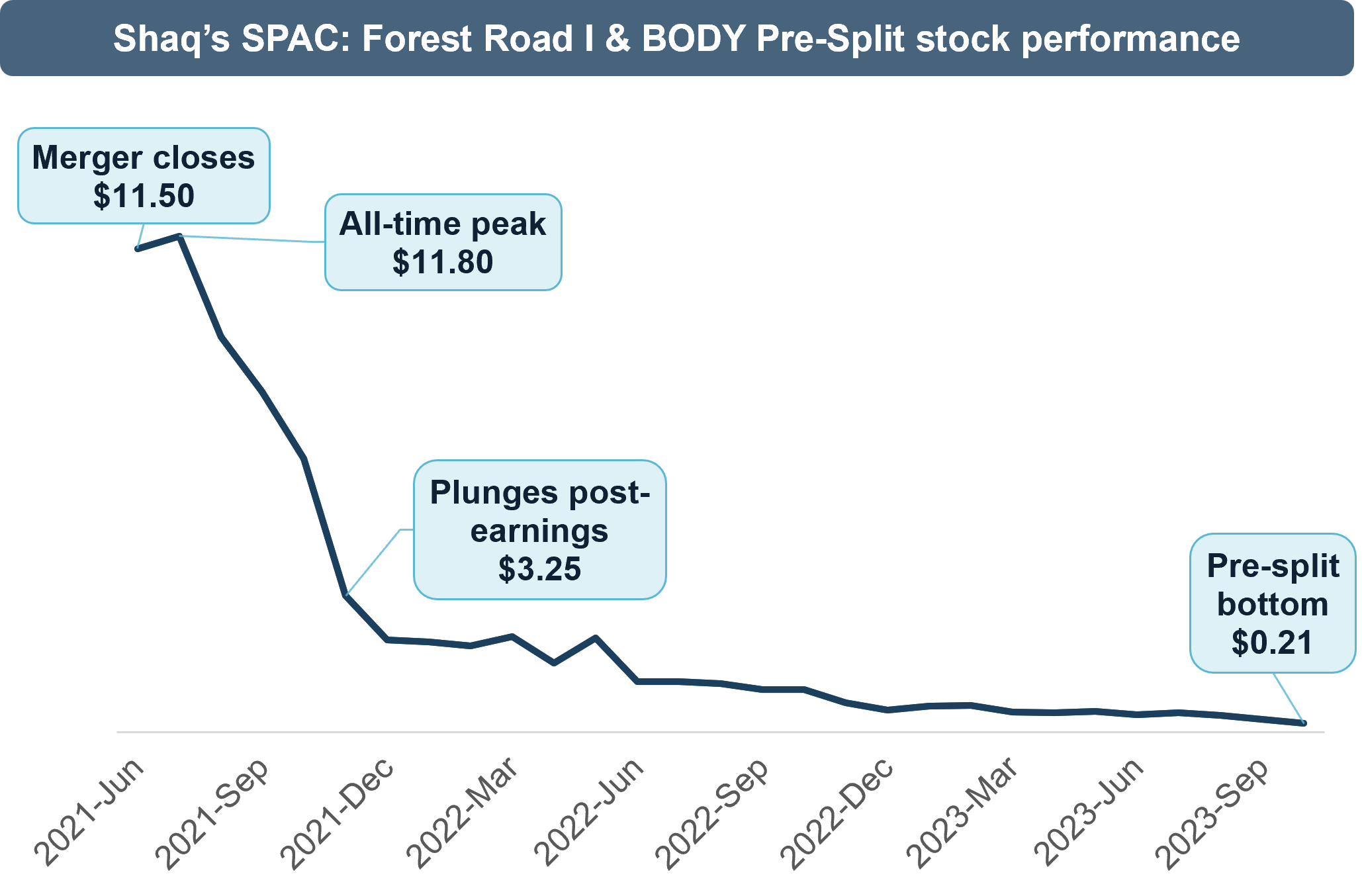
By late 2023, the stock had fallen well below $1.00, forcing the company to execute a 1-for-50 reverse stock split to keep its listing. Today, the stock hovers around $7.03 per share, which is the equivalent of just $0.14 per share before the reverse split. In total, Forest Road I and BODI lost over $3 billion in market value.
To make matters worse, shareholders filed a class-action lawsuit in June 2024 alleging that the Forest Road sponsors rushed the transaction for their own financial gain while providing misleading disclosures to public investors.
The Fate of Shaq’s Second SPAC (FRXB)
While Forest Road I managed to close its deal, O’Neal’s second vehicle, FRXB, was not so fortunate.
In November 2022, FRXB announced a proposed reverse merger with HyperloopTT, valuing the high-speed transit startup at $600 million. But the operational mountain was simply too high to climb. HyperloopTT was trying to build a 300-mile vacuum-tube transportation system connecting Chicago, Cleveland, and Pittsburgh, delivering zero near-term revenue and requiring an estimated upfront cost of $25 to $30 billion.
With interest rates climbing and the public markets freezing up, raising that kind of capital became impossible. By February 2023, the merger was officially terminated. Because FRXB could not find another target before its regulatory window closed, the fund was liquidated and the remaining cash was returned to its investors.
The Tale of Two EV SPACs: How Lucid lived, while Fisker died.
The electric vehicle sector was the ultimate epicenter of the SPAC boom. Startups requiring billions of dollars to scale manufacturing used the fast-track listing process to bypass the hurdles of a traditional IPO. But as Fisker and Lucid Motors show, listing on an exchange does not solve a fundamental cash problem.

Lucid Motors: The Struggle of Capital Intensity
Lucid Motors went public via the Churchill Capital Corp IV SPAC in July 2021 with massive expectations, aiming to compete directly in the premium EV market. However, soon after the IPO, the company faced a wall of production shortfalls, extreme cash burn, and supply chain bottlenecks. Lucid serves as a premier case study for why capital-heavy manufacturing businesses struggle under the tight timelines and structural constraints of a SPAC structure. The massive capital required to build automotive infrastructure from scratch clashed directly with the brutal quarterly expectations of the public markets. Lucid’s majority owner, Saudia Arabia’s Public Investment Fund, has invested over $5 billion post-IPO to solve the car maker’s continued cash needs.
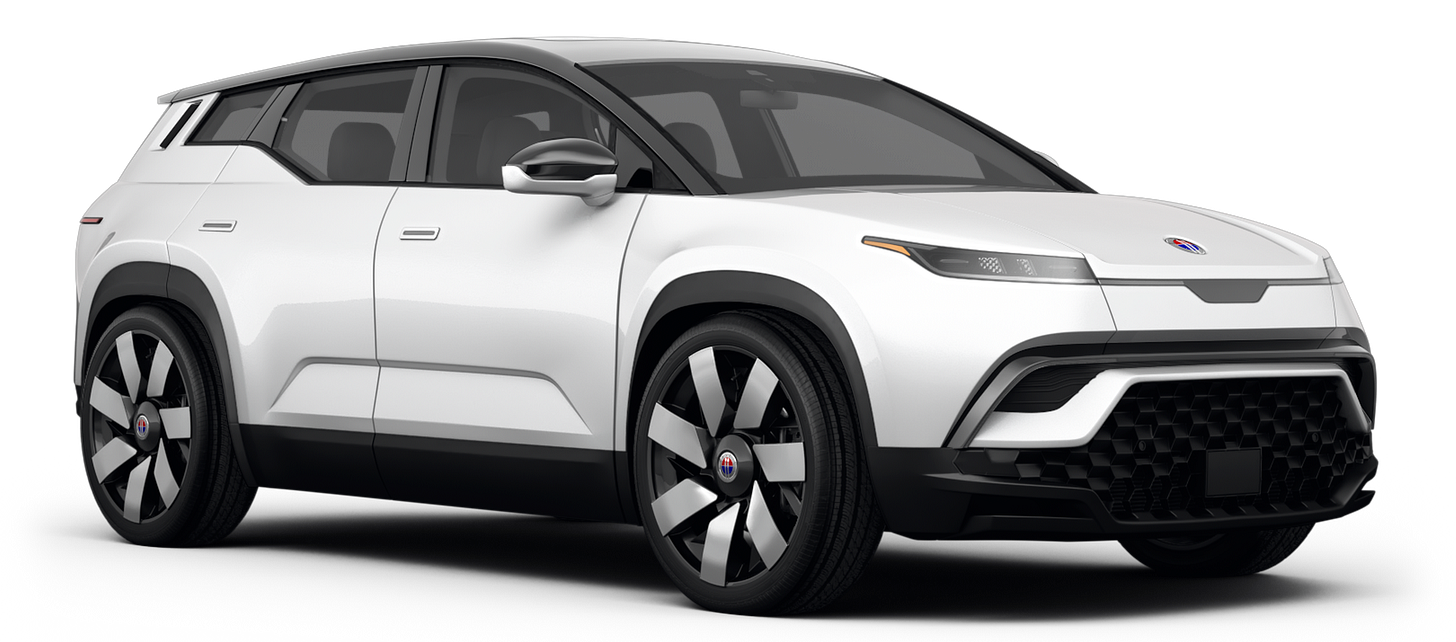
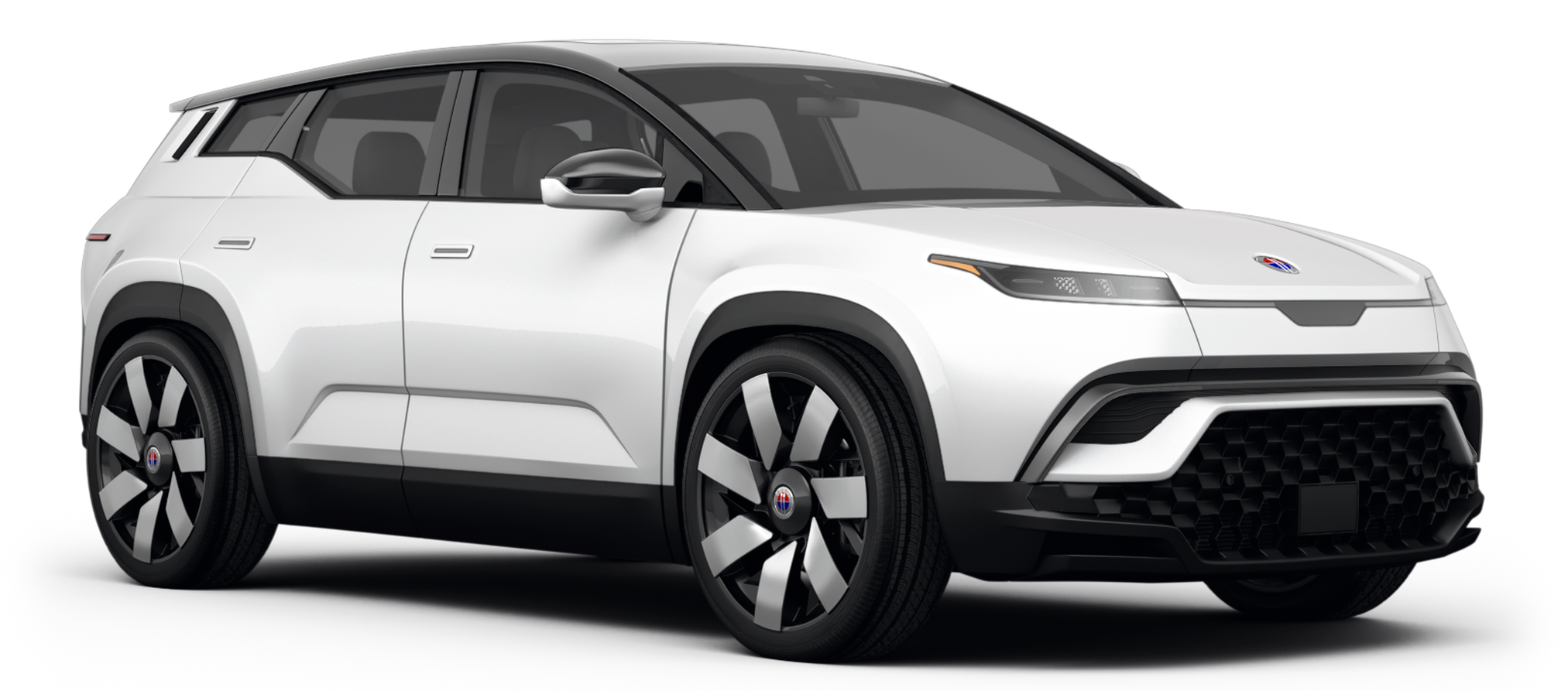
Fisker Ocean (image credit: Kelley Blue Book) Fisker Inc.: The Asset-Light Risk
Fisker attempted to sidestep the capital-intensive infrastructure by adopting an “asset-light” outsourcing model. Instead of spending billions to build its own factories, the company contracted third parties to handle the manufacturing, hoping to focus its resources on vehicle design and software. But this outsourcing model stripped Fisker of direct operational control. Delivery delays and software issues plagued its launch, and the company rapidly burned through the cash it raised from its SPAC merger in 2020. Without a massive capital cushion or an operating infrastructure to fall back on, Fisker’s financial runway simply ran out, and the company filed for bankruptcy in 2024.
© Katherine Dextraze, F Avenue Consulting, 2026
Coming Up Next: Surviving the Cash Crunch 💸
The ultimate lesson of the EV SPAC wave is straightforward: profits are an opinion, but cash is a fact.
You can have a beautiful product design, a compelling story, and a multi-billion-dollar valuation on paper—but the moment your bank balance hits zero, the business is over.
Next week, we are going to look closely at the operational missteps behind Fisker’s sudden collapse. We will look at how their cash runway evaporated, and more importantly, I will walk you through a step-by-step guide on how to build a professional 13-Week Cash Flow Forecast so you can identify and prevent major cash surprises before they threaten your business.
Hit the subscribe button below so you don’t miss next week’s practical template!
What’s your take? 💬 Do you think the stricter “SPAC 4.0” disclosure rules will help restore credibility to blank-check listings, or did the celebrity-era bubble ruin the reputation of the structure permanently? Let me know!