
Paid only: is Viasat (VSAT) undervalued?
Learn how to use the DCF like a pro to find out what a business is worth

Quick note: the following is presented as educational content only and does not represent financial or investment advice. Always perform your own due diligence or consult with a licensed financial advisor before making any investment decisions.
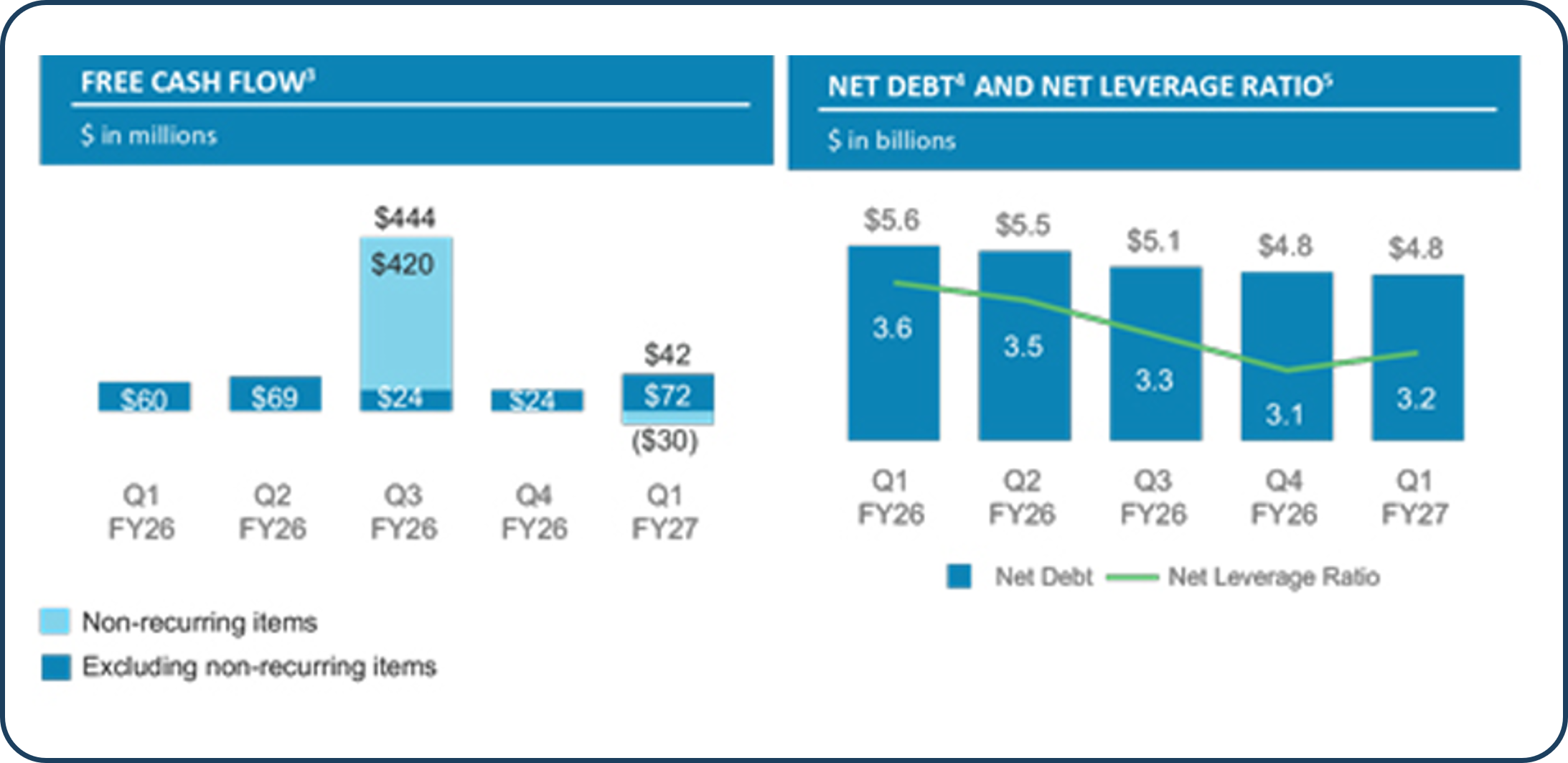
Following up on our last post about the satellite sector’s rapid consolidation, let’s look at Viasat (VSAT). After a blowout earnings announcement on August 4, Viasat’s stock popped from $73 to $86 as of close on August 4, 2026. The results looked mixed on the surface: a minor 1% top-line revenue decline to $1.15B and Adjusted EBITDA of $381M for the quarter. But underneath the headline numbers, the market cheered a significantly improved earnings per share of ($0.38), a 12% improvement over the ($0.43) from Q1’26. The EPS improvement was driven by aggressive debt paydown and lower interest expenses – alongside positive Free Cash Flow of $72M, excluding non-recurring items, for the quarter.
If you look at Wall Street research, analysts’ 12-month price targets are all over the place:
The Low Estimate: $49.00
The Average Consensus: $94.14 to $95.29
The High Estimate: $140.00
How do smart analysts look at the exact same business disclosures and arrive at targets that are $90 apart? To understand this, we can look under the hood of one of gold standards for valuing a business – the Discounted Cash Flow (DCF) model. In this post, we will take a look at Viasat’s underlying business model, estimate how the business will growth over the next five years, and deliver a range of stock prices to compare against current analyst target prices.
What Does Viasat Actually Do?
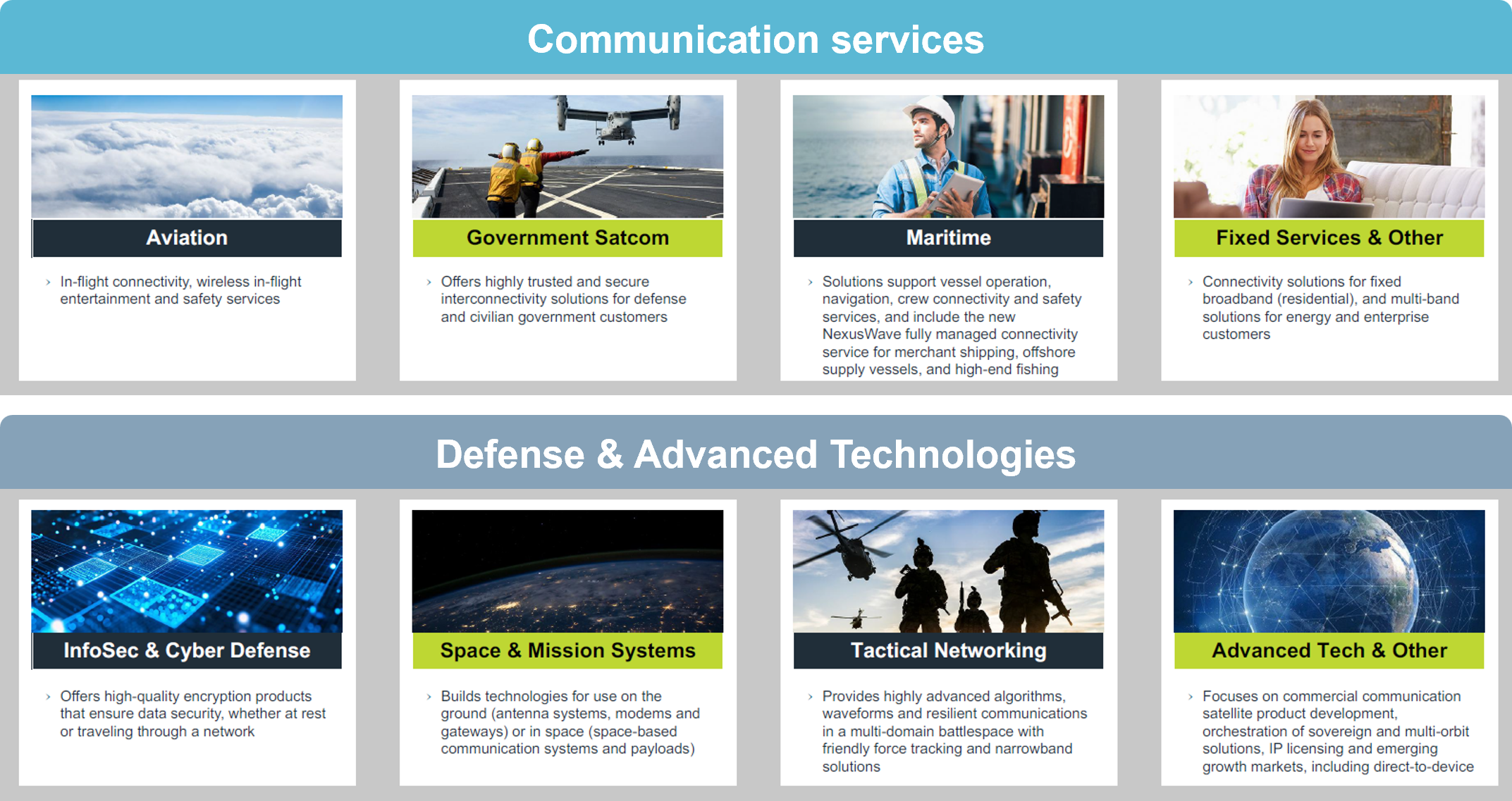
Viasat operates a massive, multi-band global satellite fleet consisting of 23 operational spacecraft. After its transformative acquisition of Inmarsat which was completed in 2023, Viasat reorganized into two distinct operating segments: Communication Services and Defense & Advanced Technologies.
What Does Viasat Actually Do?
Viasat operates a massive, multi-band global satellite fleet consisting of 23 operational spacecraft. After its transformative acquisition of Inmarsat which was completed in 2023, Viasat reorganized into two distinct operating segments: Communication Services and Defense & Advanced Technologies.
1. Communication Services
This segment provides broadband and narrowband connectivity across mobility and fixed markets. It is a tale of two different worlds:
Aviation IFC, “The Growth Engine”: Providing in-flight Wi-Fi to commercial airlines is Viasat’s crown jewel. In Q1 FY2027, aviation service revenue jumped 11% YoY, with approximately 4,530 commercial aircraft actively connected. This is high-yield, contractually locked enterprise revenue.
Fixed Services & Other (FS&O), “The Legacy Drag”: This is traditional residential retail satellite internet. Revenue from this segment fell by 27% YoY in Q1 FY2027. Why? Because Viasat is facing brutal LEO competition from Starlink and is intentionally reallocating its constrained bandwidth capacity away from low-margin consumer homes to supply its booming, high-margin commercial aircraft business.
Maritime & Government Satcom, “The Pivot”: Government satcom services grew 10% YoY, and maritime is rolling out NexusWave, a multi-orbit, multi-band managed connectivity service that bonds Ka-band, LEO, and LTE networks.
2. Defense & Advanced Technologies (DAT)
While Communication Services gets the headlines, DAT is Viasat’s structural stabilizer. This segment focuses on developing products for tactical networking, space payloads, and cybersecurity systems, divided into four key sub-segments:
Information Security and Cyber Defense: Provides military-grade, “Type 1” and HAIPE-compliant encryption solutions that protect sensitive government communication. It also includes the Move Out / Jump Off (MOJO) expeditionary tactical gateway family, which saw record contract awards of over 100 units in Q1 FY2027.
Space and Mission Systems: Designs satellite communication architectures, mobile and fixed broadband modems, ground terminals, and antennas. In Q1 FY2027, this segment secured a prime contract under the U.S. Space Force’s Protected Tactical SATCOM-Global (PTS-G) program to build and launch a dual-band X/Ka-band mini-GEO satellite.
Tactical Networking: Provides resilient communications designed for multi-domain battlespaces, including friendly force tracking systems and the proprietary waveforms developed by TrellisWare Technologies. In Q1 FY2027, this segment grew 36% YoY, fueled by strong tactical communications and TrellisWare product sales to international customers.
Advanced Technologies and Other (AT&O): Focuses on commercial communication satellite product development, direct-to-device (D2D) cellular-to-satellite integration, and high-margin intellectual property licensing. In Q1 FY2027, AT&O saw a planned decline due to lower IP licensing and royalty-based revenues.
The Equity Analyst’s Engine: How to get Cash Flow to Equity (Levered DCF)
In my previous Rosetta Stone of Finance post and series on Deep Dives into the financial statements, we explored how the three financial statements connect to one another. In a standard DCF, analysts typically project Unlevered Free Cash Flows and discount them at the Weighted Average Cost of Capital (WACC) to find Enterprise Value.
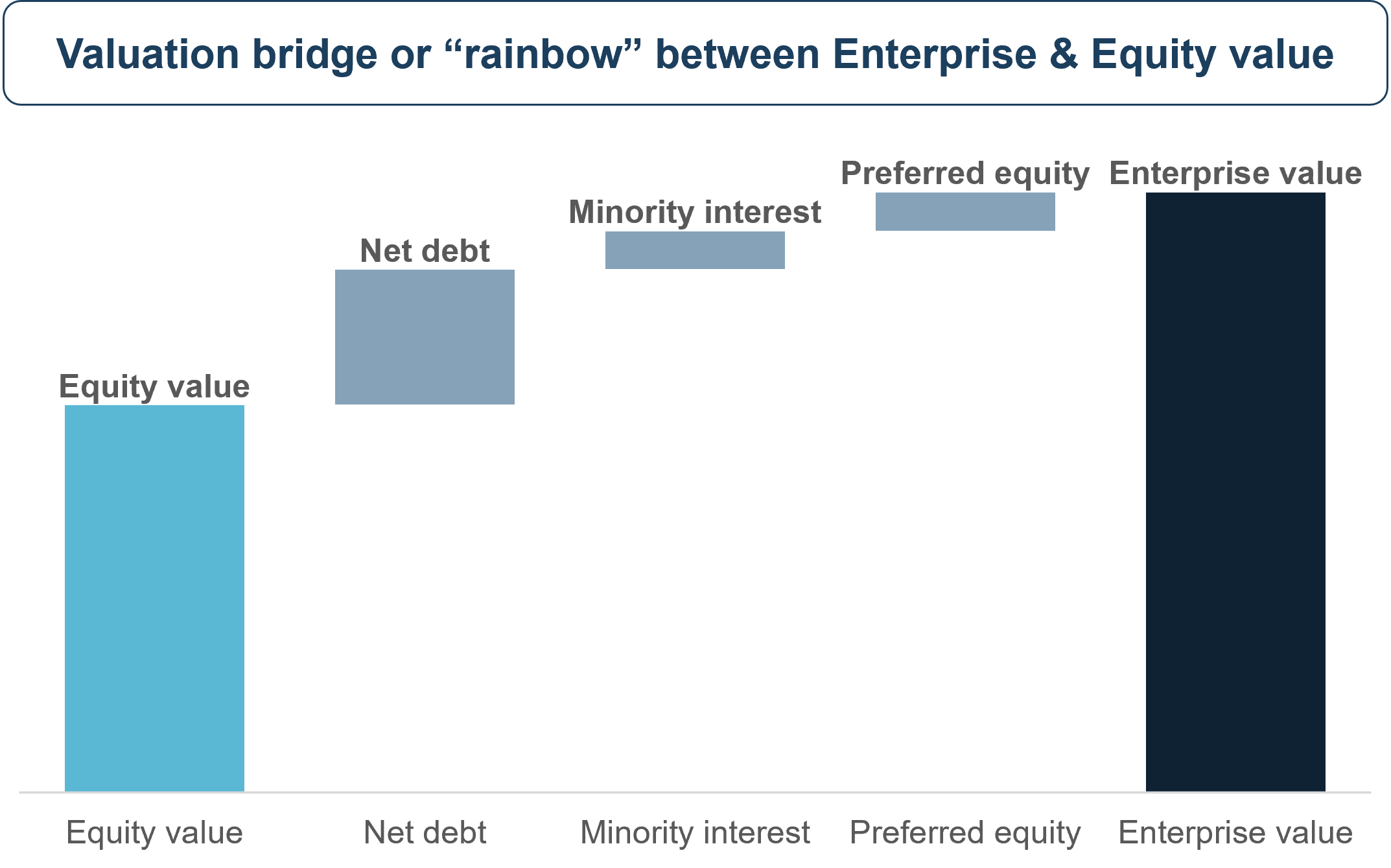
So, when we talk about “value” – we can be referring to either the equity value (or market cap) or the enterprise value (or firm value) of a company. The key difference here is who holds claim to the assets or cash flow: with equity value, common shareholders hold claim the levered cash flows; and with enterprise value, claim holders get the unlevered cash flows (these parties include the company’s common and preferred shareholders, debt holders, and subsidiaries/minority interest). To connect between equity and enterprise value, we use the “valuation rainbow” or “valuation bridge,” which typically refers to a waterfall chart such walking from equity value, adding net debt, minority interest, and preferred equity to get to enterprise value.
For equity analysts looking to estimate equity value and estimate a stock price directly, they can use Levered Free Cash Flow (Cash Flow to Equity) discounted at the firm’s Cost of Equity (requity).
Levered FCF = Operating Cash Flow − Capital Expenditures + Net Borrowing
Because Levered FCF already subtracts interest payments and debt principal movements, discounting these cash flows directly yields the Equity Value of the business. Divide that by the diluted share count (reported on the most recent 10Q or 10K), and you get your target stock price.
Learn how analysts got to their different price targets
Now that we’ve done some background research on our target company, Viasat, and we understand how to use the DCF to get to equity value, let’s take a look at how analysts may have arrived at their different price targets. We’ll start by building out a full DCF to align with the base case.
